
Research Chemical Terminology: A–Z Glossary

The research chemical supply field uses a specific vocabulary drawn from analytical chemistry, quality assurance, logistics and regulatory documentation. For anyone new to procuring reference materials for laboratory work, encountering terms like 'CoA', 'loss on drying', or 'chain of custody' for the first time without a clear definition can make even straightforward documentation feel opaque.
This glossary collects the terms most frequently encountered when reading supplier documentation, evaluating Certificates of Analysis, or managing laboratory inventory, and defines each one in plain language. It is organised alphabetically and grouped loosely by section to make specific terms easy to locate.
Where a term is covered in more depth elsewhere on this site, we note the related article so you can read further.
A–D
The first section covers foundational documentation and identity terms most commonly seen at the start of a Certificate of Analysis or product listing.
A
- Appearance: the described physical form and colour of a material as recorded during analysis, used as a basic visual cross-check against the received sample.
- Assay: another term for the quantitative purity determination of a compound, often used interchangeably with 'purity result'.
B
- Batch: a defined quantity of material produced or packaged together under uniform conditions, identified by a unique batch number. See our full article on batch numbers and traceability.
- Bulk quantity: a larger packaged amount, such as the higher tiers in a powder quantity range (e.g. 500 g or 1000 g), typically offered at a reduced per-unit price.
C
- CAS number: a unique numeric identifier assigned to a chemical substance by the Chemical Abstracts Service, used to unambiguously identify a compound regardless of naming variations.
- Certificate of Analysis (CoA): a document reporting the analytical test results for a specific batch. See our dedicated article, Certificate of Analysis Explained.
- Chain of custody: the documented sequence of custody, transfer and storage of a material from receipt through use, allowing its handling history to be reconstructed if needed.
- Chromatography: a family of separation techniques, including HPLC and GC, used to separate a sample's components for identification or quantification.
D
- Discreet packaging: neutral, unmarked outer packaging used during shipping that does not indicate the contents to outside observers.
- Documentation package: the set of accompanying documents supplied with an order, which may include a CoA, safety data information and an invoice.
E–H
E
- Excipient: an inactive substance sometimes present alongside a target compound; relevant mainly for materials supplied in mixed or diluted form rather than as a neat reference standard.
F
- Formulation: the physical format in which a reference material is supplied, such as bulk powder or pre-dosed blotter format. See our article comparing powder vs. blotter formats.
G
- GC-MS (gas chromatography–mass spectrometry): an analytical technique combining separation and mass-based identification, explained in detail in our HPLC, GC-MS and NMR article.
H
- HPLC (high-performance liquid chromatography): a chromatographic technique widely used for quantitative purity determination of non-volatile compounds.
- Hygroscopic: describes a material that readily absorbs moisture from the surrounding air, relevant to storage conditions and water content specifications.
I–M
I
- Identity confirmation: analytical work confirming that a sample is the compound it is claimed to be, often via mass spectrometry or NMR, as distinct from a quantitative purity result.
- Impurity profile: a listing of the impurities detected within a sample and their respective levels. Discussed in detail in our purity specifications article.
K
- Karl Fischer titration: an analytical method used to precisely quantify water content in a sample.
L
- Loss on drying (LOD): the proportion of a sample's mass lost under controlled heating, commonly used as an indirect measure of moisture content.
- Lot number: functionally equivalent to a batch number in most supply chains; used to uniquely identify a production or packaging run.
M
- Method reference: the specific analytical technique and conditions used to generate a reported result, which should always accompany a purity figure on a CoA.
N–R
N
- NMR (nuclear magnetic resonance spectroscopy): a structural analytical technique used for identity confirmation independent of chromatographic separation.
P
- Processing time: the period between an order being placed and it being dispatched, typically 1–2 business days for orders placed with ChemLab Kaufen.
- Purity specification: the defined acceptable range or minimum threshold for a compound's purity result, discussed fully in our purity specifications article.
Q
- Quarantine: the practice of physically and administratively separating a batch pending further review, used when a quality concern is raised before a final disposition is made.
R
- Reference material: a chemical substance supplied for laboratory research and analytical purposes rather than for consumption or application outside a research setting.
- Research use only (RUO): a designation indicating that a material is intended solely for laboratory research applications. See our dedicated explainer on what research-use-only means.
- Retained sample: a portion of a batch kept aside by a supplier for a defined period to allow future re-testing if questions arise.
- Retest date: a date after which re-analysis of a stored material is recommended to confirm it remains within specification.
S–W
S
- SEPA transfer: a euro-denominated bank transfer method within the Single Euro Payments Area, one of the payment options accepted by ChemLab Kaufen alongside cryptocurrency.
- Specification limit: the numerical boundary (minimum, maximum, or range) a tested parameter must fall within for a batch to be considered acceptable.
T
- Tracked shipping: a delivery method that provides a trackable reference number allowing the customer to monitor a shipment's progress.
- Traceability: the ability to follow a material's history from manufacture through distribution to receipt, and back again, via consistent batch identification.
U
- Unspecified impurity: a detected impurity peak that has not been individually identified, typically controlled through a generic reporting or acceptance threshold.
W
- Water content: the proportion of a sample attributable to residual moisture, measured by methods such as loss on drying or Karl Fischer titration, and reported where relevant to a material's specification.
Using this glossary alongside supplier documentation
This glossary is intended as a quick reference while reading a Certificate of Analysis, a product listing, or a shipping notification. Where a term reflects a topic covered in more depth elsewhere on this site — such as batch traceability, purity specifications, or analytical methods — the corresponding article is linked so you can explore the subject further.
If you encounter a term in ChemLab Kaufen's documentation that is not covered here or needs further clarification, the support team can explain it directly: reach out via support@chemlabkaufen.nl, WhatsApp at +49 1578 3358297, or the live chat on chemlabkaufen.nl.
Conclusion
A shared, precise vocabulary makes it far easier for laboratories and suppliers to communicate clearly about quality, documentation and logistics. Keeping this glossary on hand when reviewing a CoA or product listing helps ensure that terms like batch number, purity specification, or research use only are understood consistently rather than assumed.
For further explanation of any term used in ChemLab Kaufen's documentation, or to discuss the paperwork accompanying a specific order, contact support@chemlabkaufen.nl or WhatsApp +49 1578 3358297.
Frequently asked questions
What is the difference between a batch number and a lot number in this glossary?
The two terms are used interchangeably across most of the industry. Both refer to a unique code identifying a specific production or packaging run, allowing that quantity of material to be traced back to its analytical testing and manufacturing history.
What does 'research use only' actually mean in practice?
It indicates that a material is intended solely for laboratory research and analytical applications, not for any other use. Our dedicated article on research-use-only status explains the concept and its implications in more detail.
Why do documentation packages sometimes list a retest date?
A retest date flags a point at which re-analysis of stored material is advisable to confirm it still meets specification, since storage conditions and time can affect stability even for a batch that originally tested well.
Is 'assay' the same thing as 'purity'?
In most laboratory documentation, yes — 'assay' is commonly used as another word for the quantitative purity determination of the target compound, generated by a stated analytical method such as HPLC.
What is the practical difference between HPLC, GC-MS and NMR terms in this glossary?
Each refers to a distinct analytical technique: HPLC for liquid-phase separation and quantification, GC-MS for gas-phase separation combined with mass-based identification, and NMR for structural confirmation via magnetic resonance. Our dedicated article compares them in depth.
Why does this glossary include shipping terms like 'tracked shipping' alongside analytical terms?
Because laboratory procurement involves both quality documentation and logistics vocabulary, and readers benefit from a single reference covering both areas rather than needing to consult separate glossaries for each topic.
Browse the catalogue
Reference materials discussed in this guide
 1cP-LSD 100MCG
€ 400 – € 1.200
Blotter-Referenzmaterialien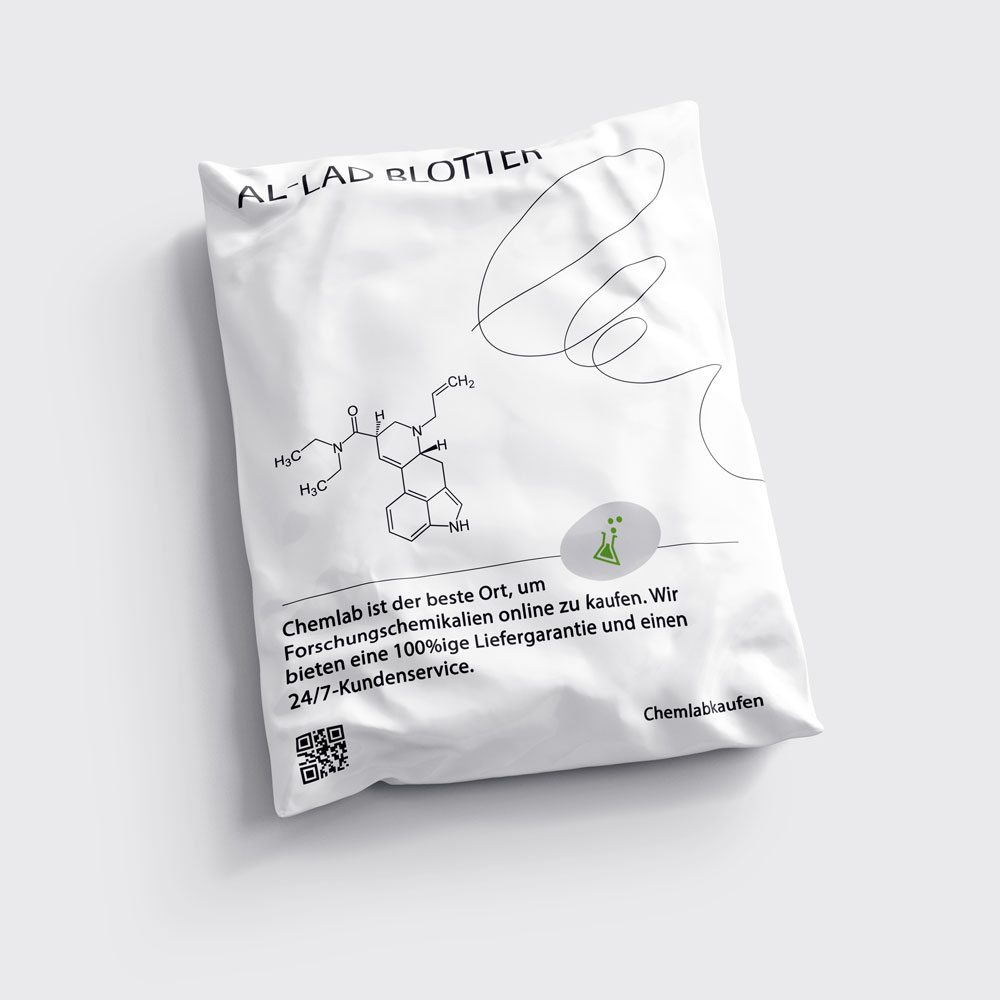 AL-LAD 150MCG
€ 350 – € 1.000
Pulver-Referenzmaterialien 4-FMA
4-FMA€ 410 – € 5.700
Pulver-Referenzmaterialien 2-FMA
2-FMA€ 375 – € 5.500
Pulver-Referenzmaterialien 6-APB
6-APB€ 390 – € 5.800
Pulver-ReferenzmaterialienRelated articles
- Certificate of Analysis Explained: How to Read a CoA
A Certificate of Analysis is the primary quality document accompanying a reference material. Here is what it should contain and how to interpret it.
- Batch Numbers and Traceability in Reference Material Supply
Batch numbering ties a physical container back to its manufacturing history and test data. Here is how traceability systems work in practice.
- Understanding Purity Specifications for Reference Materials
Purity specifications set the boundaries a batch must fall within. This guide explains how these limits are defined and what the figures actually mean.
All materials referenced on chemlabkaufen.nl are supplied strictly for laboratory and research use. They are not intended for human or animal consumption, medical use or household use.